|
|
Nautical Stock Archive - Page 1
These are some of the SOLD items that have been listed on our website
There are a maximum of 20 items on each page - our most recent sale is listed first - this is now quite a large reference record.
If you have a specific interest, use our keyword search to search the entire stock database.

|
 |
NEW STOCK |
 |
IN STOCK |
 |
FEATURED |
 |
SOLD |
 |
SOLD - similar available |
|
| Reference |
Stock Item |
|
Description |
|
|
 |
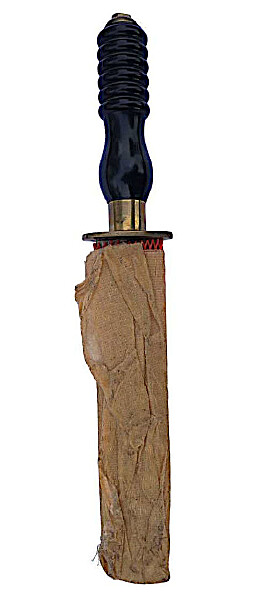
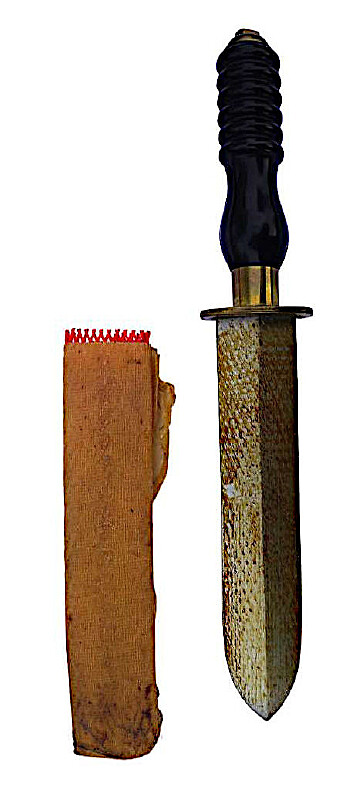
 | Unissued Royal Navy Siebe Gorman Divers Knife - A one-off opportunity to acquire a near mint and unissued ex Royal Navy Siebe Gorman divers knife that we understand is the fifth style, which was produced roughly between 1965 through to around the1980s.
It features a straight through tang and a double-edged spear point blade with simple brass quillon. The blade remains greased, thus endorsing the fact it has never been issued and for the sake of authenticity we have not attempted to remove or clean the blade. The pommel is made from brass and the nut fits tightly onto the black 6 ring "Ebonite" ribbed grip, which like the blade remains in near mint condition.
The knife comes with irrefutable provenance, being obtained directly from its owner, who acquired it whilst serving in Hong Kong in the early 1980's. Today, nearly half a century later, it remains in the same time warp condition, with the blade protected by the original factory packing, made up of orange plastic mesh that in turn is covered by some sort of oiled synthetic fabric. The blade measures 7.75" long (19.5 cm) whilst the knife, including the handle measures 13.25" (33.5 cm).This example clearly matches the collector's maxim "Always buy the best example you can afford". The sale is for the knife alone and does not include a sheath.
Please note, inline with UK law, we are forbidden to sell any knife to anyone under the age of 18 and we will require firm evidence from the buyer of this item in advance of order placement.
|
|
|
 |
| Henry Browne & Son Hand Bearing Compass - Henry Browne and Son Ltd was founded in the nineteenth century and were based at Station Works, Wakering Road, Barking, Essex. They were respected British instrument makers, who made fine quality compasses, ships clocks, barometers, inclinometers, sextants and chandlery items for over 140 years; 'Sestrel' was the company Trademark. Henry Browne Ltd was sold to John Lilley & Gillie Ltd and SIRS Navigation, both UK companies, around 1975 when the marine instrument industry was being consolidated.
Identical compasses were supplied to the Royal Navy against NATO number 6605-99-527-5338 and being finished in battleship grey we speculate ours may have once served with the Royal Navy. The optical glass prism allows the user to take a sight on a distant object whilst simultaneously reading off the bearing, taken from the image of the compass card in the prism. The compass bowl is mounted on a solid teak handle with attached card holder (the card is now missing) to make notations. Unlike many of this pattern that we have seen, the compass oil remains and with no air bubbles and the compass card swings freely. Whilst we offer for sale as a collector's item we would say, subject to checks, it is good enough to go back to sea and used as intended. Alternative it would make a fine display item in a nautical or instrument collection. It would be hard to find a crisper example and offered at a fraction of the current maufacturing cost
|
|
|
 |
| Royal Marine Officers Swagger Stick - A very good WWII period example in excellent overall condition. Similar to a riding crop, they were usually carried by military personnel as a symbol of authority, much as a schoolmaster might carry his cane-see final picture attached that will bring back negative memories to many! The Royal Marine Commandos were and are essentially the sea soldiers of the Royal Navy and their motto 'Per Mare, Per Terram' means 'By Sea, By Land', a Latin phrase that symbolises the Marines dual role as an 'elite amphibious fighting force', operating both on board ships and ashore. This example features a good clean Royal Marine crest and motto to the handle that features a Kings crown;this is not hallmarked so we have assumed it is not silver. On the opposite end the ferrule and heel tip is also in equally good condition, as is the hardwood shaft, although this does exhibit a slight bend as is often the case. Sadly, we have no history with it, but it represents a good clean example that probably saw service in WWII. Measures 27" (69 cm)
|
|
|
 |
| Royal Navy Gun Tompion from HMS Windsor - HMS Windsor, pennant number F12 was of the V/ W class destroyer of 1,100 tons, launched in 1918. She was based at Scapa Flow in the Orkney Islands, from where she served for the rest of World War and was present at the surrender of the Imperial German Navy's High Seas Fleet in November 1918. Her pennant number was changed between the wars to D 42 and she served with distinction throughout WWII, winning Battle Honours for the Atlantic 1939–1940, Dunkirk 1940, Arctic Convoys 1942, English Channel 1942–1943, North Sea 1942–1945 and Operation Overlord and the invasion of Normandy in 1944. During Operation Dynamo, the evacuation from Dunkirk, Windsor came under repeated attack but still made an amazing 6 trips and in total safely evacuated 3,991 of the stranded troops. She was then back off the coast of France for the invasion or Normandy in 1944 on convoy escort duties. Following the Japanese surrender she was decommissioned and broken up in Charlestown, Fife, Scotland, in June 1949 after 27 years of outstanding, and predominantly wartime, service.
Windsor was a 'W' Class Destroyer and following the Warship Week National Savings campaign in March 1942 she was adopted by the Urban District of Windsor, Berkshire who raised an impressive £300,000. We assume the ships badge features the famous Royal residence of Windsor Castle. The earlier 'V' Class proved to be a sturdy, reliable workhorse with sufficient stability to carry a heavier gun armament which led to the modified 'W' class on which the 4" guns were replaced with 4.7" to produce what were the fastest and most heavily armed destroyers in the world at that time. Our tompion measures 4.5" diameter (12 cm) so would have been fitted to a 4.7" gun. It is mounted on a more recent oak display shield and is cast from a substantial piece of solid brass, depicting a Kings Crown in relief. This design forms the top section of HMS Windsor's ships badge that features a silver castle, surmounted by the same Royal Crown, set against a red field, as shown for illustrative purposes only in our picture section. The official design was submitted and approved in November 1919 and likewise the ships motto "Stat fortuna domus" which translates to "May the fortune of the House stand". Below the tompion is an engraved plaque with the ships name, whilst on the reverse is a label indicating 'Gun tompion from the forward gun turret of HMS Windsor (acquired) on the ships visit to Bristol in 1936'. How this piece of Royal Naval (and His Majesty's) property came to part company with the ship 88 years ago is lost in the mists of time, but we surmise this 'loss of inventory' might be defined in retail terms as 'shrinkage'?
Whatever the story this is a rare survivor from an outstanding vessel and is the first item we have been able to acquire from HMS Windsor in the quarter of a century we have been trading and it remains in excellent original condition. Small but beautifully formed, it is definitely a one off that we are most unlikely ever to be able to repeat. It could make the ideal Christmas present for the naval collector in your life.
|
|
|
 |
| HMS Oakham Castle Ship's Nameboard - We offer for sale a very fine original nameboard from HMS Oakham Castle, a 'Castle' class corvette from WWII. Launched on 20th July 1944, she carried pennant number K530 and was 225 ft long (69 m) with a displacement of 1,100 tons. On entering service she operated on anti U boat convoy escort duties in the North Atlantic. Post-war 'Oakham Castle' joined the 2nd Training Squadron, based at Portland, but was transferred to the Air Ministry in 1958 and converted into a weather ship and renamed 'Weather Reporter'. She served in the Atlantic, to collect weather forecast information and to provide a navigation beacon service for RAF aircraft. She was finally retired and then subsequently scrapped in 1977.
Fortunately both the 'Oakham Castle' nameboards were acquired by Royal Navy collector extraordinaire Tom Ferrers-Walker; one subsequently found its way into the Oakham County Museum, appropriately located in Oakham, the county town of Rutland, and also the home of the ship's namesake castle. The other has been in my personal collection for many years; the full story is told on our website home page so does not need to be repeated here.
Suffice to say, this is a one off opportunity to acquire a very fine historic item relating to a wartime vessel which has the rare, if not unique, distinction of serving with both the Royal Navy and the Air Ministry! It is of a substantial size, measuring 93" (236 cm) in length and 9.75" (25 cm) deep. The board itself is made from hardwood - the front is now waxed and polished, whilst the rear remains exactly as it was when it came out of service. It is is fitted with its original suspension brackets. The substantial polished brass letters stand out in relief with red painted edges.
|
|
|
 |
| WWII Kriegsmarine Barograph by Lufft of Stuttgart - These instruments are becoming increasingly rare. This example was purchased by us in 2007 and has been in my personal collection these last 16 years and is only now offered for sale as I have replaced it with another slightly earlier WWI example. During our ownership it has worked faultlessly and as intended. The aluminium drum is powered by a clockwork motor, that rotates once every 7 days and provides a visual graph confirming the variations in barometric pressure over the previous week. This historic instrument is a joy to own and is a far better way of watching weather trends than listening to the TV weather forecast!
The barograph features a rotating drum and an 8-ring vacuum stack which distorts with the fluctuations in atmospheric pressure and works in the same manner as an aircraft altimeter. The articulated arm carries a pen needle on the tip and the rotating drum holds the 7-day barograph chart. The internal clockwork mechanism is fitted inside the drum and the ink recording needle and bellows are all contained within a hinged wooden case, with a fine Kriegsmarine data plate in front of the aluminium carry handle. This is riveted to the case and features an eagle with wings outstretched, an 'M' indicating Kriegsmarine Naval issue and a KM number '408'; the chromed plated brass plaque shows minor age wear to the plating. The case itself is in fine condition and with a good patina; the only minor issue is a previous owner has placed a glass or similar on the top in a couple of places that has resulted in light staining. Whilst the top could be refinished to correct this, it hardly notices when on display or in use, and is now part of the character of the instrument, that remains in fine condition, despite now being at least 80 years old.
The glazed section of the case is hinged and is locked in the closed position by securing hooks. Interestingly the inside of the instrument case carries the remains of a paper lable that appears to indicate the instrument has either been sold or serviced by the quality nautical instrument makers and retailers of Joseph Sewells of Liverpool, who were suppliers to the Admiralty ;the firm remains in business today but is no longer in family ownership. The recording drum has been hand engraved 'M1088' and '7 T' which we believe stands for '7 Trommel' in German ; trommel translates to 'drum' in English so indicates the instrument has a 7-day movement fitted. The apparent lack of manufacturers details leads us to surmise this could be a late war instrument. We have previously owned a near identical KM barograph that was made by Lufft of Stuttgart (that purported to have been owned and used by Grand Admiral Karl Dönitz but that is another story) but we have also referenced another identical instrument, illustrated in Konrad Knrim's super reference book 'German Military Timepieces', as final picture attached, that indicates this was made by Deuta-Morell of Berlin. Only today however, in taking photographs for our listing, have we discovered the truth to its origins. Engraved on the cross bar, immediately above the vacuum stack, is the single stylised word 'Lufft' so we can now finally confirm this instrument did indeed originate from the Lufft factory at Stuttgart. The company was started by Gotthilf Lufft in 1873 and of course 'Luft' in German also means 'air', so an entirely appropriate, if coincidental name, for an instrument that works on the basis of the variations in air pressure. The instrument measures 6.5" x 11"x 5.5". (16.5 x 28 cm x 14 cm.) If you require any additional information or photographs, please do not hesitate to contact us.
|
|
|
 |
| HMS Southampton Candlesticks - We have often bought and sold items of treen, made from wood salvaged from Royal Navy ships, but few match this attractive matched pair of candlesticks. They look to have been carved from pitch pine, with fitted brass sconces, but what lifts them to a new level is the hand carving to the base of each which confirms 'HMS Southampton Portion of mast, JUTLAND 31st May 1916'. The story does not end there, as they were originally presented to Engineer-Captain W. H. Mitchell R. N. (1878-1960), who served on Southampton in WWI and were subsequently inherited by his Grandson, who also advised his Grandfather went on to become a Rear Admiral.
Provenance is only of value if it can be proven and in this case a report found in the Times newspaper of 11th November 1926 confirms 'Engineer-Captain W. H. Michell has been selected for the position of Chief Engineer of the Dock Yard at Hong-Kong. Hitherto he has been First Assistant to the Manager at Chatham. In the War Engineer-Captain Mitchell was chief engineer of the cruiser Southampton'. The year of Eng-Captain W. H. Michell's transfer from Chatham to Hong Kong was 1926, and at the time HMS Southampton was at Chatham being made ready for scrapping at Pembroke Dock. It is safe to assume the candlesticks were made by Chatham Staff as a leaving gift to Eng-Captain Michell on his transfer from Chatham to Hong Kong and as a reminder of his service on Southampton in the First War.
HMS Southampton was built by John Brown & Company at their Clydebank shipyard and launched on 16 May 1912. She was assigned to the 1st Battle Squadron and she became flagship of the 1st Light Cruiser Squadron in July 1913. She had an extremely active wartime career, participating in the Battle of Heligoland Bight, and later in the Battle of Dogger Bank in early 1915. In May 1916, Southampton fought in the Battle of Jutland as flagship of 2nd Light Cruiser Squadron and was first to spot the German battle fleet when Commodore "Barge" Goodenough sent a signal back to his commander, Vice Admiral Sir David Beatty. She subsequently torpedoed and sunk the German light cruiser SMS Frauenlob. In 1917, she was transferred to the 8th Light Cruiser Squadron with whom she remained and suvived the war. In 1926 Southampton was sold for scrapping on 13th July 1926.
The candlesticks measure 7.5" high and 4" diameter at the base (18.5 cm x 10 cm). With the festive season fast approaching these historic, decorative and useful candlesticks would be the perfect present for the marine or Royal Navy collector in your life. A one-off opportunity that will never be repeated!
|
|
|
 |
| HMS Champion Temperature gauge - Purchased from a defunct West county Naval museum this small item of treen is made from teak recovered from HMS Champion, when she was broken up by Metal Industries of Rosyth, Scotland in 1933. HMS Champion was a C-class light cruiser of the Royal Navy that saw service during World War I. She was part of the Calliope group of the C class and Champion was commissioned into service in the Royal Navy on 20 December 1915. She was assigned to the Grand Fleet, serving as the leader of the 13th Destroyer Flotilla through to early 1919. She fought in the Battle of Jutland in 1916, during which she was also the flagship of the senior commander of the fleet's destroyers. She served on post war but was decommissioned in December 1933 and placed under dockyard control and finally sold for scrapping the following year.
This souvenir from the ship was almost certainly made by Lister Woodcrafts and we have seen a number of items made from HMS Champion salvage from garden benches to letter openers. This angular thermometer is quite unusual and the first of this type we have had in. The instrument is made by Rototherm and has a Fahrenheit scale from -20F to +140. The thermometer is working, although we cannot g'tee its accuracy although it is currently reading a toasy 68F in our office! The item measures 4.75" x 4.25" (12 cm x 11 cm) and the gauge diameter is 2 1/2" diameter (6.5 cm)
|
|
|
 |
| USS Maine Commemorative Quadruple Plate Dish - Manufactured by Poole Silver Co of Taunton Mass, we believe this little dish was made to honour the sinking and loss of the USS Maine (ACR-1) in Havana Harbour (Harbor) in February 1898 and so contributing to the outbreak of the Spanish–American War. The press soon got on the bandwagon and came up with the phrase "Remember the Maine! To hell with Spain! and this became a rallying cry for action. The cause of the explosion proved contentious but it served as a catalyst that accelerated the events leading up to the war with Spain.
The dish is made of Quadruple Plate which was a high quality silver plating and whilst it did not mean the plating was carried out four times it meant four times as much pure silver was used, compared with standard plating. The maker, Poole Silver Company was based in Taunton, Massachusetts, established in 1892 and were an early manufacturer of silver products made with electroplating techniques; they were taken over in 1971 by Towle Silversmiths. Our dish is named on the inside base to 'U. S. Baltic Ship' and below, whilst slightly worn, is the legend 'Sunk in Havana Harbor'. Below this is an image of the 'Maine' in relief, followed by the ships name in stylised form. Whilst not dated seeing the vessel sank on 15th February 1898 it must have been made during or after 1898 to commemorate this loss, when 260 members of her crew, three quarters of her total strength, were killed in the explosion on that fateful day. The underside of the base carries the makers marks as detailed above and in addition the number 518. We stand to be corrected but we speculate this could be the manufacturers catalogue number for this piece.
The dish measures 6.5" diameter (17 cm) and stands 2" high (5 cm), sitting on four ornate feet. The plating shows some wear, as to be expected after over 100 years and a slight bump to the edge around the 9 o'clock position but generally remains in very good display condition. How this item turned up along with a collection of British of Royal Navy related items at auction in Exeter, Devon we will never know but it almost certainly has a story to tell. Seeing this commemorates a pivotal piece of US Naval and national history we feel it is time to repatriate the dish over the pond. As with all out stock more detailed images are available and we are happy to provide a delivered price on request.
|
|
|
 |
| Pitch Pine Folding Yacht Table - Like the mahogany ships table we have also listed for sale today we have owned and used this table ourselves for close on 30 years but a new design scheme forces us to reluctantly offer for rehome. Whilst its origins are unknown it was purchased by us in the port town of Falmouth, Cornwall back in c.1990. It probably originally served on a yacht or launch where space below decks was at a premium. Our picture shows the top in the extended position and this gives a surface area of 32" x23.5" (82 cm x 60 cm); when the top leaves are closed the top dimensions reduce to a modest 32" x 11.75" (82 cm x 30 cm). It stands 24.75" high (60 cm) in the opened position.
Manufactured from a varnished pitch pine in sound condition but with marks and scuffs commensurate with use and the nautical origins are endorsed by six solid brass hinges. Sometimes on these table the legs also fold in to aid storage when not in use; this clearly was the case with this one but the legs were in the locked position when we purchased and we have left it as such although the original hinge mechanism is still in place but now non-functioning. We have found it a fine and practical piece of nautical furniture to own and whilst for sale a collectable we see no reason, if you should require a table for use on your classic boat, why it should not again go back to sea.
|
|
|
 |
| Siebe Gorman Admiralty Issue Diving Torch NSN-6230.99-520-1611 - Siebe Gorman & Co Ltd, arguably they most famous name in diving, have manufactured hand-held battery powered submarine electric torches for divers and the British Ministry of Defence since the 1920's. We have sold countless examples over the years but these have been exclusively the type most commonly found, normally with a chrome leather wrist-strap which is sewn on, with a bulls eye lens and four metal 'prongs' to protect the glass lens.
On this occasion we have been fortunate to secure a much rarer variant torch with 'Slide switch'. These were manufactured by Siebe Gorman between 1967-1969 and weigh in at a hefty 1.8 kilos or 4 lbs without batteries fitted. Made from high quality brass with an electroplated (either chrome or nickel) finish for added protection against corrosion. Our torch carries much of the original silvered exterior coating but it does show wear in the places you would expect, commensurate with service use. It is clearly stamped with the all important makers name Siebe Gorman and below the NATO stock number NSN-6230.99-520-1611 and below it is dated 1968. As all serious torch collectors will know the 5th & 6th paired numbers of the N-S-N sequence (called the 2-digit NCB) refers to the country of manufacture. For the UK the number, as here, is 99.
This torch supersedes the previous design and improves on it. A large separate 'O'-ring seals the lens housing; the batteries are isolated in a grey painted and non-conductive inner metal tube, and is complete with a conical compression spring at the end of the battery housing to lock three 'D-size', 1.5 volt dry cell batteries in place. These would give a maximum burn time of 1 to 2 hours. The torch is not fitted with batteries and we can't warrant if it is still in working order so for sale purely as a collectable. The rugged, simple construction of all Siebe Gorman Military issue torches enables them to operate within the depth parameters of most normal Royal Navy diving limits and is safe to operate down to 80 meters. Unlike on later torches it does not carry a wrist strap but there is a lanyard hole on the curved metal end plate which is stamped on this torch with an 'X' which we speculate is a Royal Navy quality acceptance mark. The torch measures 11" long (28 cm) and the diameter of the lens end is 3.25" (8.5 cm) It weights a hefty 4.0lbs without batteries (1.8 kilos)
As with all our stock feel free to drop us a mail and request further photographs so you can check out the detail and specification.
|
|
|
 |
| HMS Nelson Copper Tray - HMS Nelson was a Battleship of 33,500 tons launched in 1925, serving throughout WWII with distinction and won Battle Honours for MALTA CONVOYS 1941-42, NORTH AFRICA 1942 -43, MEDITERRANEAN 1943, SICILY 1943 -,SALERNO 1943, NORMANDY 1944. Having survived that lot she was finally broken up in 1949. These little trays were offered for sale onboard via the NAAFI shop to serving crew members and were mainly bought as gift for friends and relations back home. This came in with a small collection and are all period items and would make a great gift for anyone with an association with this fine ship. This example carries a stamped 'HMS Nelson' ships badge to the centre of the tray. Measures 3" diameter (7.4 cm)
|
|
|
 |
| HMS Galatea Copper Ashtray - HMS Galatea was a Cruiser launched in 1934 and weighed 5,220 tons and served with distinction in WWII. Her luck however ran out on 14th December 1942 when she was sunk by torpedoes from U-557 off Alexandrea. Sadly Captain Sim, 22 of his Officers and 447 Ratings were killed. These little trays were offered for sale onboard via the NAAFI shop to serving crew members and were mainly bought as gift for friends and relations back home. This and the rest of the small collection we are listing today are all of the period and would make a great gift for anyone with an association with this fine ship. Measures 4.25" diameter (11.0 cm)
|
|
|
 |
| Royal Navy Napkin Rings - A set of 7 matching napkin or serviette rings, manufactured by George Walker of Sheffield, a business established in Sheffield in 1845. He was joined by Henry Hall and in 1853 to form Walker & Hall. In 1963 they amalgamated into The British Silverware Ltd. together with Mappin & Webb and Elkington & Co. Our rings carry the company logo of W & H set into a pennant and in addition they are all marked KF18008 and are are dated either 1956 or 1957 together with a broad arrow military property mark. George Walker also manufactured napkin rings for the RAF but in this instance with the decorative naval design to the rims we feel almost certainly these were destined for their Lords at the Admiralty 60 odd years ago. Another desirable feature is four of the seven rings carry additional marks '26', '3', 'K5', K69' which we presume would have identified the original owner. The other three are 'Plain Janes' -or is that another expression in our PC world we are no longer supposed to use? I use it anyway, with apologies to any 'Jane's' reading this listing and I hope you know where we are coming from!
These are quality rings and the plating is all absolutely sound and whilst they would sit happily in a nautical or Royal Naval collection we see no reason why they should not continue to serve in their intended role for those special Mess Nights you may hold either ashore or afloat! Each measures 1.75" internal diameter (4.5 cm)
|
|
|
 |
| Junghan's Radio Room Clock WWII - Another interesting ships clock we are listing today. This pattern was in use from 1939-1945 and served with both Kriegsmarine and Civilian vessels of the period. We have also seen similar examples issued to and used by the Bundeswehr post WWII but our understanding is these tended to be chrome plated whilst this example carries a brass case. We have found an identical example detailed in Ziggy Wesolowdki's excellent reference book on Military Timepieces and also in volume 3 of the book 'Kriegsmarine Uniforms and Traditions'.
Whilst we have not looked inside the case we are told the movement is a Junghan's W146. The silvered dial is not in the best condition but we can decipher the Junghan's star logo below the 12 o'clock position. In addition we can just make out the remains of the green and red diagonal radio silence bars that would have originally have run in the vertical and horizontal positions signifying 3 minute zones when the radio operator would have observed radio silence in case any May Day calls were being broadcasted. The numerals have also become worn and have been touched in by a previous owner. We can find no evidence of a Kriegsmaine property mark being added and whilst this may have been rubbed out we believe this clock was issued to a Civilian vessel in which case this would have been omitted.
When purchased the seller made no mention of any provenance with this clock. However on close inspection we discovered scratched on the back some old and quite crude letter reading 'Franken'. Whilst our research has located a U boat commander, Wilhelm Franken of U- 565 we believe it more likely this clock served on an auxiliary ship of the Kriegsmarine known as a Troßschiffverb. Since Germany in WWII did not have any overseas bases, naval operations in the North Atlantic required supply ships and tankers called "Troßschiffe". In addition to using former civilian tankers five supply ships, the Dithmarschen class, were built to service warships with fuel, ammunition, general supplies and spare parts. The 'Franken' was one of these and was commissioned in March 1943 and operated in the Baltic Sea, where it supplied the Prinz Eugen and other smaller ships of the German Navy in the last months of the war. She was blown apart and sunk near Hela in April 1945 by the Russian Airforce.
If our clock served on the 'Franken' it had clearly been removed, perhaps for repair, before she was lost. Certainly the age and model of this timepiece all lines up exactly although we have found the same specification also being used in the radio room of U boats, as confirmed by that on the U- 995 which still exists. Whatever the provenance it is a fine and increasingly scarce example of the type that could perhaps be improved if a donor dial could be located or the existing one tidied up a little. It is ticking away happily in our office but as we have no idea when the movement was last checked a service would probably not go amiss. As with all our stock more detailed pictures are available on request. Measured on the back plate the diameter is 7.9" (20.0 cm) and is 3.4" deep (8.5 cm). The brass case has three strong brass lugs for bulkhead mounting.
|
|
|
 |
| Kriegsmarine Protractor - A very large instrument manufactured by Dennert & Pape of Hamburg-Altona and also stamped with a waffenampt and the code M 1V/1. Constructed from hardwood (possibly beach) with a scale from zero to 180 degrees on the curved section and 0-50 cm along the base. In generally very good issued condition with minor expansion in the timber at the joints. We would assume the instrument would have been used either at H. Q. for training purposes in the classroom or possibly for a crew briefing prior to an operation. We have only ever seen one other example and would represent an unusual addition to the specialist Kriegsmarine, Nautical or instrument collection. 19.75"x20.5"x10.75" (50 cm x 27 cm)
|
|
|
 |
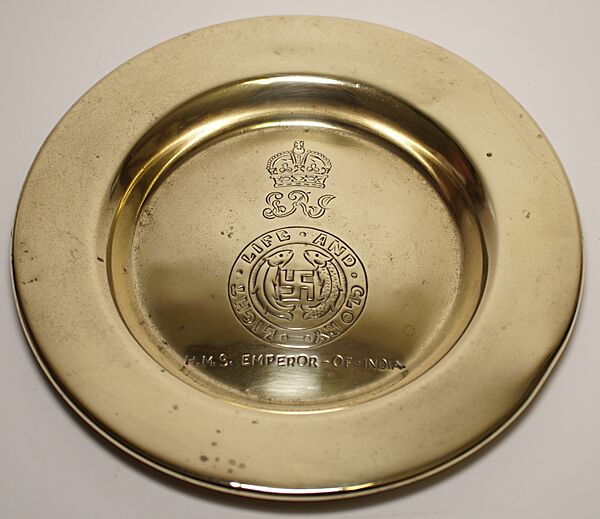
| HMS Emperor of India Trench art Tray - Emperor of India was a dreadnought battleship of the Iron Duke Class built at Vickers in Barrow-in-Furness. She weighed in at 30,000 tons and was 622' l from stem to stern. She was intended to be called HMS Delhi but it is reported the change was to honour HM King George V who was 'King of the United Kingdom and the British Dominions, and Emperor of India'. Launched in November 1913 HMS Emperor of India joined the 4th Battle Squadron of the Grand Fleet, based at Scapa Flow. She took part in numerous sorties into the northern North Sea to enforce the blockade of Germany but missed the Battle of Jutland as she was in for a refit. Post war she was sent to lend support to the White Russians and Allies in the Russian Civil War which had by mid-1919 reached the shores of the Black Sea. HMS Emperor of India was finally paid off in Portsmouth in January, 1931. The ship provided one final service to the Navy by serving as a gunnery target, along with HMS Marlborough. The tests included firing destroyer armament at the upper works at close range to test their effectiveness in a simulated night engagement and she finally sank off Owers Bank.
This brass tray appears to be of trench art rather than commercial origins but beautifully crafted. It is engraved with a Kings Crown with the cypher GRI below. Then enclosed withing a circular device is the legend 'Light, life and Glory' and withing two fish, one with scales and one without and to the centre is a swastika device. This is known as a right-handed swastika, which in Hindi, stands for wisdom, luck and riches. It was only when the Nazi's adopted it in 1933 that the swastika took on a completely different and more sinister meaning.
The final photograph attached shows the ships diving party with an identical plaque to the centre. The tray measures 5.75" diameter (15 cm) and would make an ideal gift for the Royal Navy collector in your life.
|
|
|
 |
| Barker's of Kensington Ships Clock - Barkers of Kensington was a department store in Kensington High Street, London. It was started by John Barker and James Whitehead, later Lord Mayor of London, in 1870. It was sold to House of Fraser in 1957 and was closed in 2006. This fine brass cased clock was clearly made for Barker's and marketed by them, probably in the 1930's.
It features a 7 day movement and the standard advance and retard lever mounted at the 12 O'clock position. The silvered dial is generally very good good with just the odd age related mark ; it is 6 1/2" diameter (16 cm) and it the timepiece is 3.5" deep (9 cm) measured from the bulkhead mounting plate. It features a heavy cast brass bezel ring with black painted steel hour and minute hands with a smaller seconds subsidiary dial above. A label to the back of the case indicates it was last serviced in 2010 ; whilst we have not checked the movement it has been running perfectly in the time it has been with us but the new owner may wish to have it oiled and checked.
A fine quality clock from a famous London retailer that would be happy to either go back to sea or to make a real statement on your kitchen or bathroom wall!
|
|
|
 |
| HMS Raleigh Copper Ashtray - Six Royal Navy ships have carried the name HMS Raleigh and of course the current shore station at Torpoint. It is our feeling this tray relates to the Cruiser launched in 1919 and which was subsequently run aground in thick fog off the cost of Labrador in 1922 and was lost together with 11 of her crew. Her Master was subsequently charged with negligence. It may of course relate to the shore station but we believe the Cruiser mentioned is the more likely candidate. These little trays were offered for sale onboard via the NAAFI shop to serving crew members and were mainly bought as gift for friends and relations back home. This and the rest of the small collection we are listing today are all of the period and would make a great gift for anyone with an association with this fine ship. This example carries an applied brass badge featuring the 'HMS Raleigh' ships crest. Measures 3 1/2" diameter (9.0 cm)
|
|
|
 |
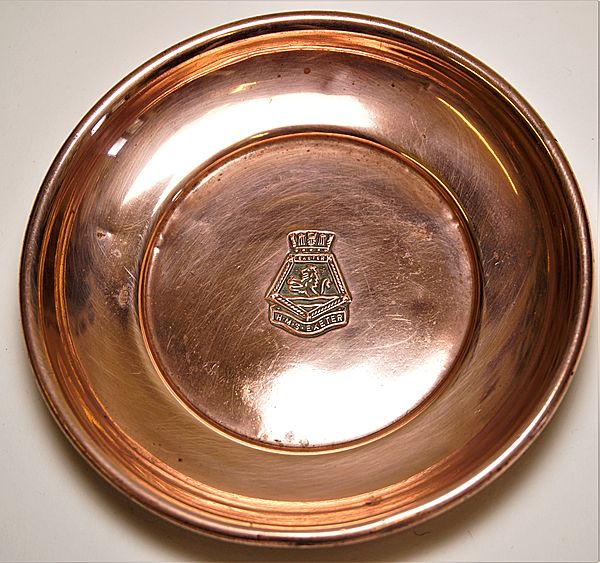
| HMS Exeter Copper Ashtray - HMS Exeter was a Cruiser launched in 1929 and weighed 8,390 tons and served with distinction in WWII. She famously took part in 'The Battle of the River Plate' but her luck ran out in 1942 when she was sunk by Japanese dive bombers off Java in 'The Battle of the Java Sea' with the sad loss of 50 crew; a further 150 subsequently lost their lives as Japanese POW's. These little trays were offered for sale onboard via the NAAFI shop to serving crew members and were mainly bought as gift for friends and relations back home. This and the rest of the small collection we are listing today are all of the period and would make a great gift for anyone with an association with this fine ship. This example, as well as carrying an embossed 'HMS Exeter' badge, is also stamped in fine script on the reverse'Made in England'. Measures 3.65" diameter (9.4 cm)
|
|
 |
 |